

Honoring Valor


South 9 News:
Special story
Honoring Valor
Police Commemoration Day in Andhra Pradesh
—————————–
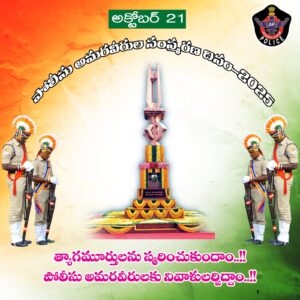

Police Commemoration Day, observed annually on October 21 across India, stands as a solemn tribute to the unwavering dedication and ultimate sacrifices of law enforcement personnel who safeguard the nation. In Andhra Pradesh, this observance resonates deeply, reflecting the state’s commitment to honoring its brave officers amid ongoing challenges such as counter-insurgency operations and disaster response. As the state prepares for the 2025 commemorations, this article explores the historical significance of the day, its evolution in Andhra Pradesh, and the multifaceted events planned to perpetuate the memory of fallen heroes.

The origins of Police Commemoration Day trace back to a tragic incident on October 21, 1959, when ten Central Reserve Police Force (CRPF) personnel from India’s Intelligence Bureau were ambushed and killed by Chinese troops during a reconnaissance mission at Hot Springs in Ladakh’s Aksai Chin region. This ambush, part of escalating border tensions that foreshadowed the 1962 Sino-Indian War, underscored the perilous duties undertaken by police forces in frontier defense. In 1960, the Indian Parliament formalized October 21 as Police Commemoration Day through a resolution, establishing it as a nationwide platform to remember not only those ten martyrs but all police personnel lost in the line of duty. Today, the day symbolizes resilience and selflessness, with over 35,403 officers having sacrificed their lives since India’s independence in 1947. It serves as a poignant reminder of the police’s role in upholding law and order, combating extremism, and protecting civilians, often under dire circumstances.
In Andhra Pradesh, the observance has evolved into a week-long Martyrs’ Commemoration Week, extending from October 21 to 31, blending remembrance with community engagement. This format amplifies awareness of the police’s contributions to public safety, particularly in a state historically affected by left-wing extremism and natural calamities. The Andhra Pradesh Police, under Director General Harish Kumar Gupta, have integrated Rashtriya Ekta Diwas (National Unity Day) themes, emphasizing national integration and the force’s role in it. For 2025, preparations underscore a holistic approach: exhibitions on police history, “Open House” sessions for public interaction, essay and elocution competitions for students, and mock drills simulating rescue and anti-terror operations. These initiatives not only educate but also foster empathy, highlighting how officers confront threats from Maoist insurgents along the Andhra Pradesh-Odisha border—a region where numerous personnel have perished in ambushes over the decades.
The week’s commencement on October 21 features central events at venues like the Indira Gandhi Municipal Stadium in Vijayawada, where Chief Minister N. Chandrababu Naidu is expected to participate, as he did in 2024, laying wreaths and addressing gatherings on achieving a “zero crime rate” through systemic reforms. District-level Smriti Parades, such as those at the Andhra Pradesh Special Police (APSP) 6th Battalion and 11th Battalion, involve floral tributes, photo exhibitions of recent martyrs, and salutes by contingents. In Sri Sathya Sai district, Superintendent of Police S. Satish Kumar outlined visits to martyrs’ villages from October 22 to 30, encouraging locals to name public spaces after the fallen, alongside seminars in schools and colleges on police duties. Medical camps and blood donation drives on October 28 promote community service, while cultural programs on October 29 showcase police heritage through performances.
Culminating on October 31, the week concludes with Unity Runs and candlelight rallies, symbolizing solidarity and illuminating the path of remembrance. In Anantapur, for instance, past events have included blood donation camps led by Superintendents of Police, reinforcing the force’s ethos of giving back. Financial aid, such as ₹10,000 cheques to families of martyrs and merit scholarships for their children, underscores governmental support, as seen in Alluri Sitharama Raju district where 12 families received assistance in 2024. Governor S. Abdul Nazeer, in his 2024 message, echoed this sentiment, paying homage to those who “sacrificed their lives while performing their duties of safeguarding the people and the society.”
The significance of these observances in Andhra Pradesh extends beyond ritual; they address real-time sacrifices. In the past year alone, 216 police and paramilitary personnel nationwide laid down their lives, including two from the state, often in anti-Naxal operations or disaster relief like the Vijayawada floods. Ministers like Kinjarapu Atcham Naidu have lauded the force’s role in curbing extremism and ensuring peaceful elections, announcing welfare measures such as job quotas for martyrs’ kin. As live webcasts from the National Police Memorial in New Delhi accessible via official channelsconnect state events to the national narrative, Andhra Pradesh’s efforts inspire a collective resolve.
In conclusion, Police Commemoration Day in Andhra Pradesh transcends commemoration, embodying a pledge to valorize service and support the bereaved. By weaving education, engagement, and empathy into its fabric, the state not only honors its guardians but also fortifies the societal bonds they protect. As echoes of parades and rallies fade, the flame of their legacy endures, guiding future generations toward a safer tomorrow.

- Advertisement -


Comments are closed.